
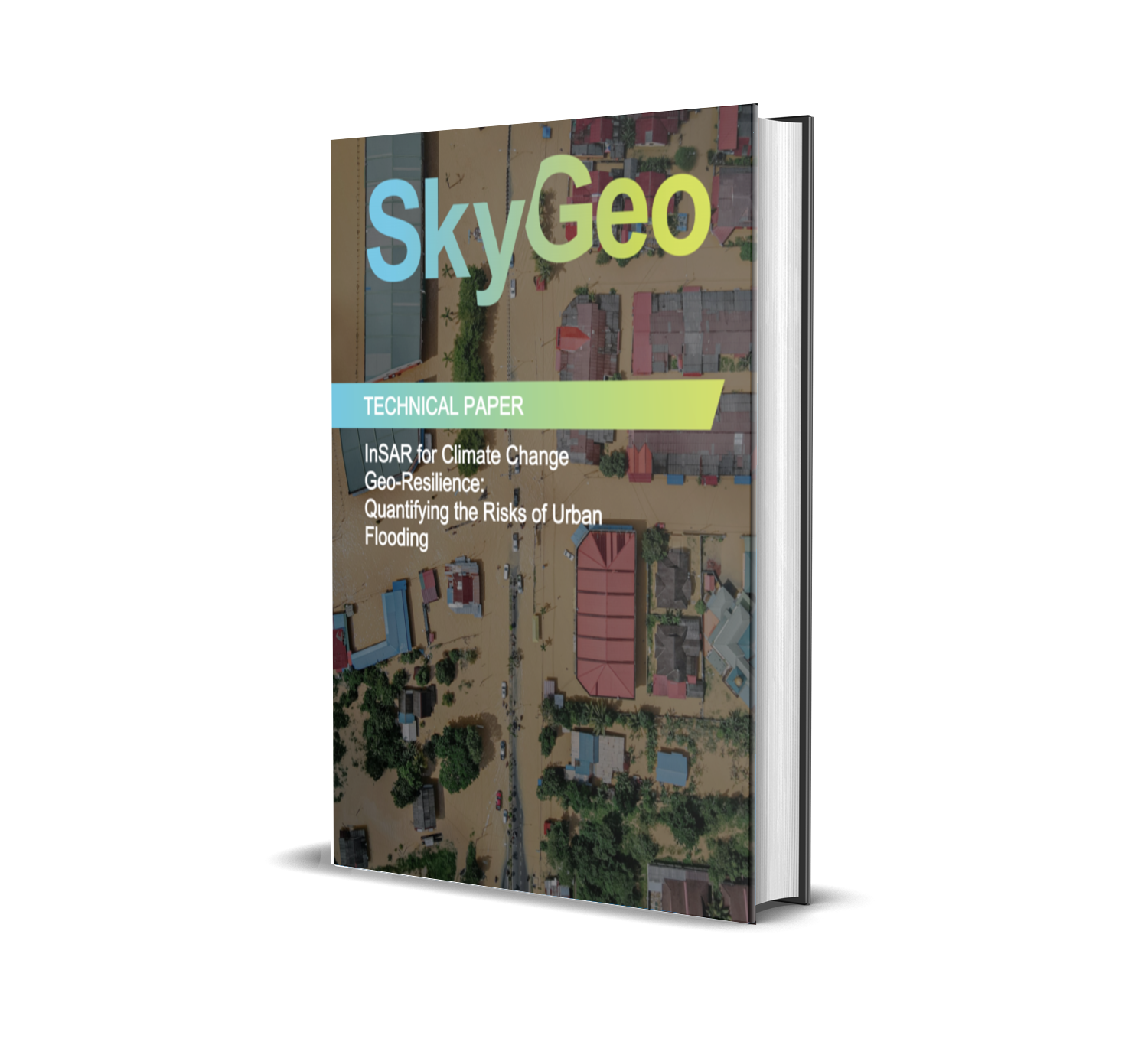
InSAR for Climate Change Geo-Resilience: Quantifying the Risks of Urban Flooding
Technical Paper
This paper discusses the application of Interferometric Synthetic Aperture Radar (InSAR) to quantify the risks of urban flooding and foundation damage related to climate change effects, particularly in the Netherlands.
Learn how high-resolution Interferometric Synthetic Aperture Radar (InSAR) can quantify the risk of urban flooding by estimating building settlement rates with millimetre-level precision.
Understand how combining InSAR data with digital elevation models (DEMs) allows for critical projections on when buildings will reach a flood-susceptible height below NAP (Normal Amsterdam Level).
Discover how municipalities can use InSAR-derived settlement rates to define and communicate specific risk thresholds for homeowners based on projected damages and future door sill heights.
See how large housing corporations like Ymere use InSAR-based risk indicator maps to assess foundation health, informing maintenance budgets and planning for renovations such as solar panel installation.
Learn how InSAR time series analysis reveals the direct effect of climate change, correlating drought summers with new permanent settlement in buildings on shallow foundations.